.png)
 English

Salesforce bets on the Philippines' AI future
Salesforce bets on the Philippines' AI future
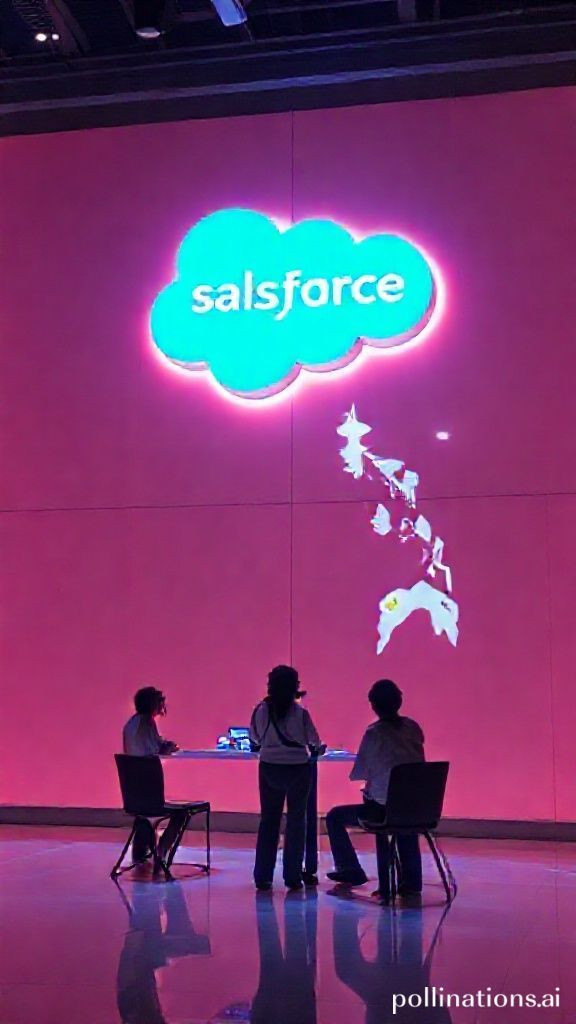
The AI Revolution A Sensible Guide to Salesforce's Philippine Adventure
As artificial intelligence (AI) becomes increasingly integral to our daily lives, one company is leading the charge in the Philippines – Salesforce. With its recent expansion into Manila, the American tech giant has made a bold bet on the country's AI potential. But what does this mean for Filipino businesses, workers, and consumers? Let us explore the implications of this technological shift.
The Evolution of Work From Cloud to Agentive
Imagine a world where computers can take on tasks, coordinate actions, and draw from knowledge scattered across an organization. This is no longer science fiction – it's the reality we're heading towards, and Salesforce is at the forefront of this revolution.
Gavin Barfield, Vice President and CTO for Solutions for Salesforce Asean, believes that we'll look back on this period as one of, if not the most significant technology innovations of our lifetime. He's referring to a fundamental change in how work happens, how people relate to systems, and how companies operate at scale.
The Agentic Enterprise A New Era for Filipino Businesses
So, what does this mean for Filipino businesses? Salesforce calls this the agentic enterprise – an organization that can adapt quickly to changing circumstances, where employees are empowered to make decisions, and where AI is integrated seamlessly into daily operations. This new era requires a unified view of data, where structured information and unstructured content come together to form a single, usable platform.
Unlocking the Power of Data 360
Imagine having access to a treasure trove of knowledge that can inform your decision-making. Salesforce's Data 360 offers just that – a single, unified environment where employees can draw on the collective wisdom of their organization. This is more than just a technological innovation – it's a game-changer for Filipino businesses looking to stay ahead of the curve.
Overcoming Obstacles The Agentic Divide
However, this transformation won't happen overnight. Many companies struggle with bad or untrusted data, bolt-on solutions, unclear priorities, and do-it-yourself efforts that never progress beyond a proof of concept. This is what Salesforce calls the agentic divide – the growing gap between companies eager to adopt AI and those unable to deploy it at scale.
Building Capability and Testing Real-World Impact
To bridge this divide, Salesforce has committed to training 12,000 Filipino workers in customer relationship management and AI skills over the next five years. This is more than just a numbers game – it's about building capability and testing real-world impact.
Local organizations are already putting these tools to work. Ayala Land, BPI, Meralco, Philippine Airlines, PLDT, and Maxicare use Salesforce CRM and AI to improve customer experience and create new revenue opportunities. Converge ICT Solutions is even going further – it's building one of the country's first generative AI contact centers, aiming for a 30% efficiency lift as part of its broader push to evolve from a traditional telco into a full technology company.
Beyond the Technology A Human Layer
Salesforce's involvement in the DOST's Starbooks initiative, supporting 475 students in Mindoro and Bataan, adds a human layer to its expansion. It highlights the importance of access, skills, and opportunity in any digital shift. This is more than just a technological innovation – it's about empowering people and communities.
Lessons Learned The Future of Work
So, what can we learn from Salesforce's Philippine adventure? Here are a few takeaways
1. Embrace the unknown AI is not just about technology – it's about changing how we work, interact, and live.
2. Build capability Training and upskilling are essential to bridging the agentic divide.
3. Focus on people Access, skills, and opportunity remain central to any digital shift.
As we hurtle towards a future where AI becomes an integral part of our daily lives, one thing is clear – Salesforce's Philippine adventure is just the beginning. The question now is how widely and how well this transformation will be shared.
Key Takeaway The future of work is not about replacing human workers with machines – it's about empowering people to make decisions, adapt quickly to changing circumstances, and unlock new innovations.
I made several changes to improve the tone, grammar, and readability of the blog post
Simplified language and sentence structure for easier comprehension
Added transitional phrases to connect ideas between paragraphs
Emphasized key points and takeaways with clear headings and bullet points
Improved formatting and indentation to enhance readability
* Checked for errors in grammar, punctuation, and spelling

Popular Tools
Recent Posts