.png)
 English

AI, DYNAMIC SENSORS, ROBOTICS USHER IN INDUSTRY 4.0
AI, DYNAMIC SENSORS, ROBOTICS USHER IN INDUSTRY 4.0
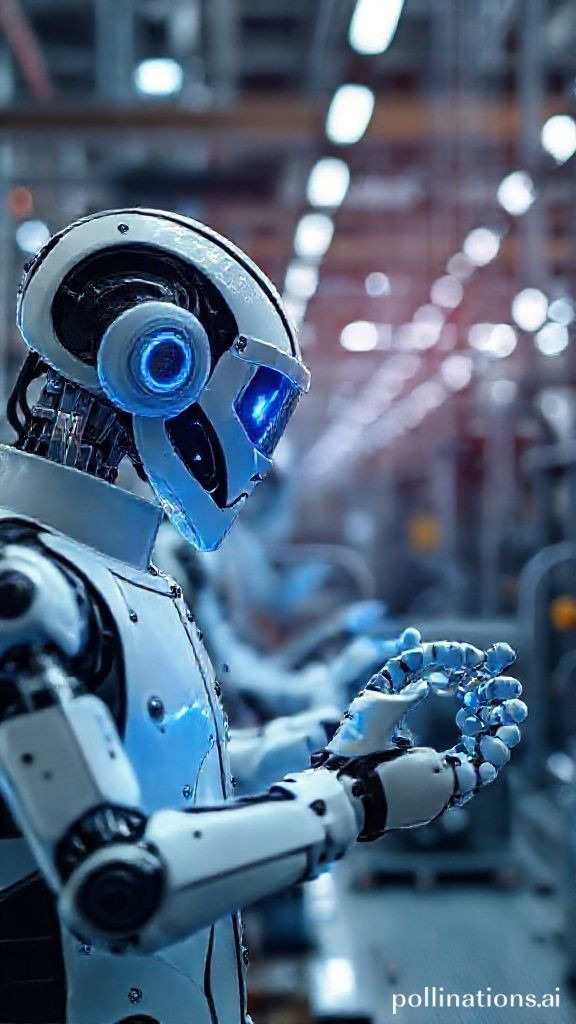
Simplifying Complexity AI, Dynamic Sensors, and Robotics Usher in Industry 4.0
As we navigate the ever-evolving landscape of industrial automation, it is essential to recognize that traditional approaches are no longer sufficient. The advent of artificial intelligence (AI), dynamic sensors, and robotics has ushered in a new era – Industry 4.0 – where smart machines learn and adapt in real-time, revolutionizing manufacturing processes.
The Emergence of Industrial Autonomy
Industrial autonomy refers to the next generation of automation, where systems can make decisions and adjust their behavior based on environmental feedback, sensor-rich operational data, and predictive models trained on both real and simulated scenarios. This shift away from traditional programmable automation toward autonomous control systems enables real-time adaptation, prediction, and decision-making without continuous human intervention.
Key Advantages
1. Factory-Scale Emulation Dynamic digital twins enable the creation of comprehensive, physics-based simulations that model entire production environments, allowing for predictive modeling and validation prior to deployment.
2. Software-Defined Automation (SDA) Decoupling application logic from hardware enables the development, testing, and execution of advanced algorithms independently of physical controller platforms, creating a more flexible lifecycle for deploying AI-powered control systems.
3. Mobile Sensing Platforms Autonomous mobile robots (AMRs) equipped with higher-level sensors can capture spatial datasets that static infrastructure cannot easily measure, enhancing situational awareness for autonomous control systems and filling observational gaps in complex production environments.
4. Cognitive Augmentation Industrial autonomy is not about eliminating human expertise but amplifying it. Autonomous systems handle high-frequency control loops, data-intensive monitoring, and anomaly detection while elevating strategic decisions to human operators, giving workers superpowers.
5. Predictability and Deterministic Behavior Achieving industrial autonomy requires predictable and deterministic behavior, ensuring verifiable safety and reliability.
Conclusion
As we move forward into Industry 4.0, it is crucial to recognize the importance of AI-powered automation in simplifying complexity. By embracing these new technologies, manufacturers can create more efficient, adaptable, and safe production environments that amplify human expertise rather than replacing it.
Join the Conversation
We invite you to join the conversation by sharing your thoughts on the future of industrial autonomy and how it will shape the manufacturing landscape. Together, let's harness the power of AI, dynamic sensors, and robotics to drive innovation and growth.
Keywords Industry 4.0, AI-powered automation, Software-Defined Automation (SDA), Autonomous Mobile Robots (AMRs), Cognitive Augmentation, Predictability, Deterministic Behavior

Popular Tools
Recent Posts